

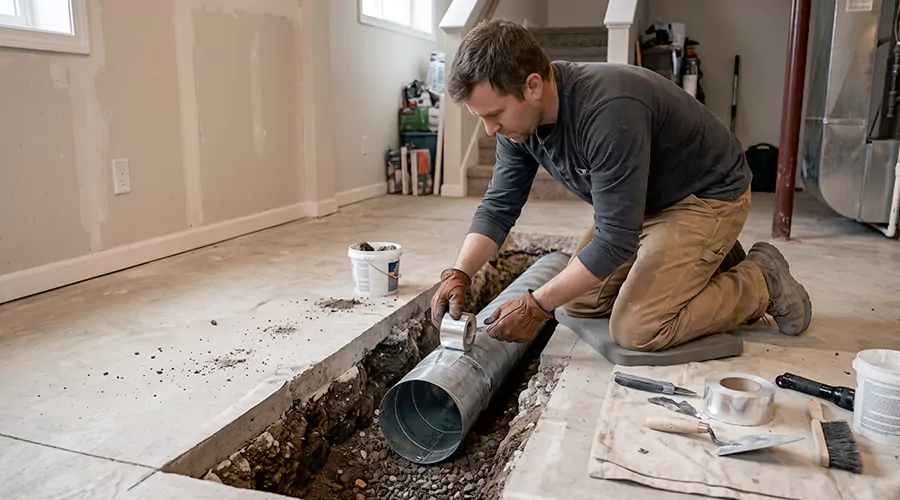
Repairing in-slab ductwork begins with inspecting the underground ducts to identify leaks, standing water or structural damage. Some sound ducts may be suitable for specialized sealing or rehabilitation, but collapsed or repeatedly flooded sections often require abandonment and rerouting. Unlike exposed ductwork, ducts embedded in or beneath concrete cannot usually be repaired through ordinary household patching, making professional air duct repair essential for determining the most practical solution.
In-slab duct systems are found in some older homes built on concrete foundations. These systems use passages within or beneath the slab to distribute heated or cooled air to floor registers. Because the ductwork is surrounded by concrete or soil, damage can remain hidden until airflow problems or water intrusion become noticeable.
The correct repair depends on the duct material and the condition of the surrounding foundation. A small opening in a sound duct presents a different problem from a collapsed passage or one repeatedly filling with groundwater. An inspection should establish whether the existing system can be restored safely or whether an alternative duct route is more practical.
What Is In-Slab Ductwork?
In-slab ductwork is a heating and cooling air distribution system installed within or beneath a concrete floor slab. Conditioned air travels through the concealed passages and enters rooms through floor registers. Some systems use metal ducts, while older installations may contain other materials that require special handling.
These ducts are different from ductwork installed in a crawlspace beneath a raised floor. Crawlspace ducts may be accessible from below the house, but true in-slab ducts are surrounded by concrete or buried beneath it. This makes direct repair difficult because the damaged sections cannot be reached without specialized access.
The design was used in some mid-century homes where the heating equipment supplied air through the floor. Certain systems were later connected to central cooling equipment as well. Moisture conditions can become more complicated when cold air moves through underground passages that are difficult to insulate or keep dry.
The main concern is not simply the age of the installation. A sound underground system may continue functioning, while a damaged system can allow water or soil-related contaminants to enter the airflow path. Evaluating its condition is more useful than automatically recommending replacement based on age.
What Causes In-Slab Ductwork to Fail?
In-slab ductwork can fail because of moisture intrusion or deterioration of the original duct material. Settlement around the foundation may also damage underground sections. Unlike attic ducts, below-slab systems are difficult to inspect directly, so deterioration may continue for years before the cause becomes obvious.
Groundwater Entering the Ducts
Groundwater can enter an underground duct through openings in the duct wall or connections. This may occur when surrounding soil becomes saturated after heavy rain or when drainage around the foundation is inadequate. Water can collect at low points because the duct system is not intended to function as a drainage pipe.
Repeated flooding can introduce sediment and keep the interior damp. Even after the visible water disappears, deposits may remain inside the passage. Cleaning without correcting the entry point or surrounding drainage conditions may leave the same problem likely to recur.
Corrosion of Metal Ducts
Metal ducts exposed to soil moisture can corrode as protective coatings deteriorate. The corrosion may begin near seams or locations where water collects. Over time, the metal can weaken and develop openings that allow air leakage or groundwater intrusion.
A small visible rust spot near a floor register does not establish that the entire system is damaged. However, corrosion deep beneath the slab may be more extensive than the accessible area suggests. Internal camera inspection can help identify deteriorating surfaces before repairs are selected.
Soil Movement and Foundation Settlement
Soil movement can place stress on underground ducts and their connections. Expansive soils may change volume as moisture conditions vary, while settlement can alter the support beneath buried passages. These movements can damage duct joints or contribute to deformation.
A cracked duct does not necessarily mean the foundation is structurally failing. However, evidence of slab movement deserves separate assessment when duct damage occurs near other signs of foundation distress. Repairing the air passage without addressing significant movement may not provide a lasting solution.
Collapsed or Crushed Duct Sections
Some underground duct materials can deteriorate until the passage loses its original shape. A partial collapse reduces the available space for airflow, while a complete failure may block the passage to one or more rooms. Cleaning will not restore a duct that has structurally collapsed.
A major restriction can cause the affected floor register to deliver very little conditioned air. However, weak airflow can also result from closed dampers or equipment problems. A camera inspection and airflow assessment help distinguish physical collapse from other causes.
Water Damage and Internal Contamination
Damp underground ducts may collect sediment or other material entering through damaged sections. When water remains present, mold can develop on suitable surfaces or debris. Porous materials may be particularly difficult to restore after prolonged water exposure.
A musty odor can indicate damp conditions but does not prove that every underground passage contains mold. The actual contamination and source of water should be identified before cleaning is recommended. Repeatedly introducing chemicals into a flooded duct will not correct the underlying problem.
Aging or Unidentified Duct Materials
Some older in-slab systems were constructed using asbestos-cement material commonly called Transite. Not every underground duct contains asbestos, but the possibility matters before anyone cuts or mechanically abrades an unidentified passage. Material age and appearance alone cannot reliably establish its composition.
Suspected asbestos-containing ductwork should be evaluated by a qualified specialist before disturbance. Ordinary grinding or aggressive duct cleaning may release hazardous fibers if asbestos is present. Repair planning must account for this possibility rather than treating every duct as conventional sheet metal.
What Are the Signs That In-Slab Ductwork Needs Repair?
Underground duct problems may first become noticeable through changes in room airflow or unexpected moisture near floor registers. Because the ducts cannot be seen directly, several observations may be needed to identify the source. Moisture-related symptoms are particularly important because they can indicate groundwater entering the system.
Common warning signs include:
- Water collects at the bottom of a floor supply register.
- One room receives much less conditioned air than other rooms.
- A musty or earthy odor develops when the blower operates.
- Mud or sediment appears inside a floor vent opening.
- Rust or deterioration is visible in an accessible underground metal passage.
- Airflow problems worsen after periods of heavy rain.
- Several registers connected to one branch become weak.
- Unusual debris is released through supply openings.
- The same underground duct requires repeated cleaning after flooding.
- A camera inspection reveals separated or collapsed sections.
These symptoms do not automatically identify the same problem. A blocked register can reduce airflow without any underground duct damage, while water near a vent may originate from a separate plumbing issue. The timing and location of the symptoms provide important clues.
Moisture appearing after heavy rain deserves particular attention. It may indicate that water is entering through a damaged duct or foundation-related opening. The source should be identified before the affected passage is dried or cleaned.
How Do You Inspect In-Slab Ductwork?
In-slab duct inspection normally begins at accessible floor registers and the HVAC equipment connection. The objective is to determine whether the passages contain structural damage or unwanted water. A visual check from the room is useful, but concealed sections generally require specialized inspection.
Step 1. Record the Affected Rooms
Begin by identifying which floor registers have weak airflow or unusual moisture. Note whether the symptoms occur only in one room or affect several openings connected to the same system. Record the date and any relationship to recent rainfall.
This information helps identify the possible affected branch. If only one register is weak, the cause may be local. If several nearby openings experience the same problem, damage may involve a larger shared section.
Step 2. Inspect Accessible Register Openings
Turn off the HVAC system before examining an accessible floor opening. Remove the register cover only if it can be safely lifted without damaging the surrounding floor. Use a flashlight to look for standing water or visible debris near the top of the passage.
Do not reach blindly into an underground duct. Sharp metal and unknown debris may be present, particularly in older systems. If the material is unfamiliar or appears to be deteriorating, avoid scraping or disturbing it.
Step 3. Check for Moisture
Determine whether the opening contains actual water or simply has a damp appearance. Photograph any standing water or sediment before it is removed. A recurring water problem should be treated as evidence requiring investigation rather than ordinary dust accumulation.
Do not try to dry a flooded duct by operating the HVAC blower. Moving air through contaminated or unidentified material can distribute unwanted particles into occupied rooms. The water source should be identified before normal use resumes.
Step 4. Arrange an Internal Camera Inspection
A suitable inspection camera can examine concealed duct sections for corrosion or structural defects. The inspection may identify standing water or separated connections that cannot be seen from a floor register. Recorded footage also helps document the condition of individual branches.
Camera results should be interpreted alongside the duct material and moisture history. A camera may reveal visible defects, but it does not measure every air leak or determine whether unidentified material contains asbestos. Additional assessment may be necessary before invasive work.
Step 5. Evaluate Airflow and Leakage
Airflow testing can help determine whether a restricted passage is reducing conditioned air delivery. Duct leakage testing may also identify substantial openings within the system. However, pressure measurements alone do not always locate the exact defect beneath the slab.
A complete evaluation should consider both physical condition and HVAC performance. Cleaning is not the appropriate solution when the primary problem is structural collapse. Likewise, rerouting may not be necessary when a limited defect can be repaired safely and durably.
What Are the Main Methods for Repairing In-Slab Ductwork?
In-slab duct repair options depend on whether the existing passage remains structurally sound. Some limited problems can be addressed without cutting the foundation, while severely deteriorated systems may need to be abandoned. The selected method must also account for material safety and the potential for future water intrusion.
| Repair Method | Suitable Situation | Main Limitation |
|---|---|---|
| Localized repair through accessible opening | Damage near a register or accessible fitting | Cannot reach every underground defect |
| Specialized internal rehabilitation | Structurally sound duct approved for the method | Not suitable for every material or damaged condition |
| Controlled concrete access | Localized structural damage needing direct repair | Can affect flooring and foundation elements |
| Replacement beneath slab | Underground route must be reconstructed | Significant demolition and restoration |
| Rerouting through attic or walls | Existing underground system is unreliable | Requires new duct design and installation |
| Abandoning old in-slab ducts | Existing passages will no longer be used | Old openings must be handled appropriately |
No single method is appropriate for every home. The inspection should determine whether the passage can remain in service before any rehabilitation product is selected. A heavily deteriorated duct should not be treated as sound simply because a coating can be applied to some accessible surfaces.
Can In-Slab Ducts Be Repaired Without Breaking Concrete?
Some in-slab ducts may be repairable without breaking the slab when the passage remains intact and the damaged area is suitable for a specialized method. The feasibility depends on the duct material and the size of the defect. A minor leakage problem is different from a collapsed section with missing structural support.
Certain specialty contractors offer internal lining or coating systems for suitable underground ducts. These products are intended to create a barrier on accessible internal surfaces. Their compatibility and long-term performance must be evaluated for the specific material and conditions.
A coating cannot reliably restore a passage that has collapsed or become severely deformed. It also cannot correct ongoing groundwater pressure surrounding the duct. Applying a product over wet debris or contaminated material may leave the underlying problem unresolved.
Older asbestos-cement ducts need additional consideration. No lining or encapsulation method should be assumed safe without a qualified material assessment and a product specifically approved for the intended use. Mechanical preparation that disturbs asbestos-containing material can create significant hazards.
How Do You Repair a Localized In-Slab Duct Leak?
A localized underground duct leak may be repairable when inspection identifies the defect and confirms that the surrounding material remains sound. The method depends on whether the opening is near an accessible register or deep beneath the concrete. The repair must restore the intended air passage without creating a route for additional water intrusion.
Confirm the Leak Location
The first step is establishing whether air is escaping through a damaged joint or whether the duct is physically restricted. Camera inspection and leakage testing may provide complementary information. A leak near an accessible boot presents different repair options from one beneath the center of the slab.
Identify the Duct Material
Determine whether the affected passage is metal or another material before selecting the repair. Older asbestos-cement ductwork requires special precautions and should not be cut or ground without appropriate assessment. Unknown material should not be treated as ordinary sheet metal.
Assess Water and Structural Conditions
A suitable repair must account for any continuing groundwater intrusion or foundation movement. Sealing an opening may be ineffective when surrounding soil remains saturated and the duct has multiple weak sections. Water control should be included in the repair plan where it contributes to failure.
Select an Appropriate Repair Method
The contractor may recommend direct access or another specialized method when the passage remains restorable. A simple duct mastic patch that works on an exposed attic joint cannot be assumed suitable for a buried opening. Material compatibility and long-term durability matter more than choosing the least disruptive technique.
Verify the Repair
After completing the work, the repaired passage should be evaluated for airflow and leakage. Any prior standing water problem must also be addressed. Restoring airflow without correcting water intrusion may leave the duct vulnerable to another failure.
When Should In-Slab Ductwork Be Abandoned and Rerouted?
Abandonment and rerouting become practical options when existing underground ducts are structurally unsound or repeatedly affected by water. A new duct system can often be routed through an attic or other suitable building space. This avoids depending on damaged passages beneath the foundation.
The new system must be designed around the home's heating and cooling needs. Duct sizes and register locations affect the volume of air reaching each room. Simply replacing underground floor outlets with smaller ceiling branches may create comfort problems when airflow requirements are not considered.
Abandoning the old ducts also requires proper treatment of unused openings. Floor registers may need to be sealed or removed as part of the renovation. The closure method should account for moisture or possible soil gas entry rather than leave concealed pathways into the building.
A rerouting project can be more extensive than a localized repair, but it may provide a more durable solution when the underground passages are no longer serviceable. The decision should reflect inspection findings and the long-term condition of the system.
What Are the Risks of Cutting a Concrete Slab to Repair Ducts?
Cutting concrete to access underground ducts can affect more than the ventilation system. A foundation slab may contain reinforcement or embedded utilities, and some slabs are post-tensioned. Unplanned cutting can damage structural components or services beneath the floor.
Before invasive work, the slab construction and utility locations must be identified. A structural engineer may be needed when cutting could affect foundation performance. Homes with post-tensioned slabs require particularly careful planning because damaging a tendon can be extremely dangerous.
Concrete cutting also creates dust and may disturb older duct materials. Appropriate containment and material identification are necessary before demolition begins. The repair should be planned as a building project rather than a simple opening in accessible ductwork.
How Much Does In-Slab Ductwork Repair Cost in 2026?
In-slab ductwork repair costs vary more widely than ordinary accessible duct repairs because direct access can require concrete cutting and floor restoration. General residential duct repairs are commonly estimated at $200 to $2,100 in 2026, but that range does not represent a reliable price for major below-slab work. Underground repairs require a scope-specific estimate.
Published 2026 planning estimates for more substantial slab duct projects suggest the following broad budgets. These should be treated as preliminary project ranges rather than established nationwide averages.
| Project Type | Indicative 2026 U.S. Budget |
|---|---|
| Inspection and diagnosis | Depends on camera and testing scope |
| Localized repair with accessible defect | Requires a site-specific estimate |
| Partial under-slab excavation and repair | Approximately $2,500 to $12,000 |
| Rerouting ductwork through accessible upper spaces | Approximately $3,500 to $20,000 |
| Extensive in-slab duct replacement | Approximately $8,000 to $25,000 or more |
These estimates cover different scopes and should not be added together automatically. A project requiring structural engineering or asbestos-related controls can exceed preliminary budgets. Flooring restoration and new register locations may also account for a significant part of the final cost.
The most useful estimate explains the condition of the existing ducts and the proposed repair route. A lower price may not provide lasting value if water intrusion remains unresolved. Comparing repair with complete rerouting is appropriate when several underground branches have deteriorated.
Can Damaged In-Slab Ducts Affect Indoor Air Quality?
Damaged underground ducts can create indoor air quality concerns when openings allow water or soil-related material to enter the airflow path. Persistent dampness can support mold growth on suitable surfaces and deposits. The actual exposure depends on the duct condition and whether contaminated material is distributed through the system.
Below-slab ductwork may also interact with soil gases when openings communicate with surrounding soil. Radon is a particular consideration in areas where the gas is present beneath buildings. Testing the home's radon level may be appropriate when underground duct defects or other soil gas entry routes are suspected.
An unusual odor does not automatically prove that mold or radon is present. Radon cannot be identified by smell, and musty odors can come from several moisture sources. Testing and physical inspection should focus on the actual suspected condition.
When Should You Call a Professional?
Professional evaluation is appropriate whenever underground ductwork shows recurring moisture or suspected structural damage. The concealed location makes ordinary household patching unreliable for many failures. A qualified HVAC contractor can assess airflow and arrange inspection of the internal passages.
The project may also require specialists outside HVAC work. Older suspected asbestos-cement ducts need appropriate material assessment, while foundation cutting may require structural engineering. Recurring groundwater intrusion may call for a separate drainage or foundation evaluation.
A complete repair proposal should explain whether the existing ducts are suitable for continued use. It should also identify how moisture will be controlled and whether old passages will be abandoned. The decision should be based on documented conditions rather than repeated cleaning of an inaccessible problem.
How Can You Prevent In-Slab Ductwork Problems?
Preventing underground duct damage primarily involves managing water around the foundation and monitoring the condition of the existing system. Not every below-slab duct problem can be prevented through household maintenance, but recurring moisture should never be ignored. Early investigation may identify a manageable defect before major deterioration occurs.
Control Water Around the Foundation
Keep gutters and drainage systems functioning so roof runoff does not collect near the building. Check that surrounding grading directs surface water away where appropriate. Persistent water accumulation near the foundation should be investigated because it can affect concealed building components.
Monitor Floor Register Conditions
Inspect accessible floor openings for standing water or unusual sediment. Photograph any recurring deposits and note whether they appear after heavy rain. Avoid introducing cleaning chemicals or water into an underground duct to remove odors.
Maintain Proper HVAC Filtration
Replace accessible HVAC filters according to manufacturer instructions. Proper filtration reduces the amount of ordinary household dust circulating through the system. However, filtration cannot prevent groundwater or soil gas from entering through a damaged underground duct.
Investigate Problems Before Remodeling
If a home has older in-slab ductwork, consider its condition before major flooring or HVAC renovations. A camera inspection may reveal problems that could affect the design of a future heating and cooling system. Planning around the existing duct condition can prevent unnecessary demolition later.
Conclusion
Repairing in-slab ductwork requires identifying underground damage before choosing a repair method. Sound passages may support limited rehabilitation, but collapsed or repeatedly flooded ducts often require rerouting. Moisture problems and older duct materials can add significant safety concerns. Professional inspection is necessary before invasive work. This week, document any water or airflow problems at your floor registers and have recurring symptoms evaluated.